Case file / E.02 · Concept build
Commitment Extractor
Every meeting an executive records gets read once at end of day. Every promise they personally made comes back out, carrying the person it is owed to, the room it was made in, and the date it comes due. One page lands on the desk at 4:45, already filtered by a human, and fifteen minutes closes the loop on all of it.
The Problem
Executives make commitments out loud all day. I will send you the deck. Let me connect you with our CFO. Give me until Friday and you will have an answer. Most of them land. The ones that do not are rarely the ones that mattered least, they are the ones nobody wrote down.
What that costs is not a missed task. It is credibility, spent with the exact people the executive was working to build it with. Meeting notes are built to capture decisions and to assign work to other people. Almost nothing in the stack captures what the principal themselves just promised.
The gap between the number of promises an executive makes in a day and the number anyone writes down is where this lives.
The Solution
The obvious build is a keyword list. Watch the transcript for I will send you, flag the line, done. That fails, and it fails quietly, because people do not repeat themselves. The same promise arrives as I will get that over to you, or let me put something together, or I will circle back once the board has seen it. A list catches one shape and misses every other one.
So the read is a language model over the transcript rather than a pattern match, and it is scoped to the lines the executive said themselves. That scoping is the part that matters. A commitment made to an executive is not a commitment they owe, and a page that blurs the two is a page nobody trusts a second time.
Then a person reads it before the executive does. I clear what already went out during the meeting itself, merge the same promise made twice in two different rooms, and pass on only what is still genuinely open. The executive confirms. They never triage.
The Brief
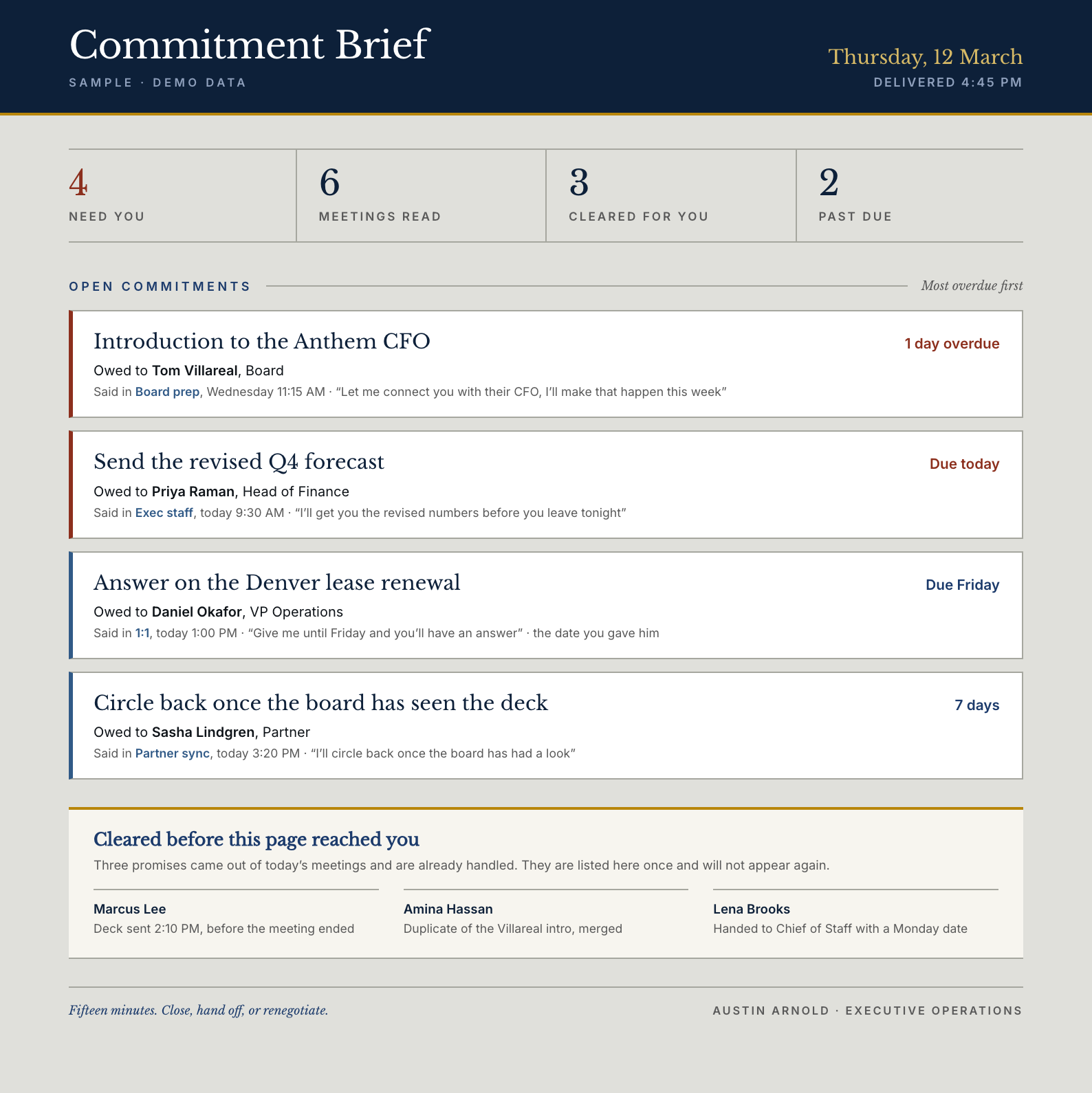
This is what arrives at 4:45. Every line names what was promised, who is owed it, the meeting it came out of, and the executive's own words, so the claim can be checked before it is acted on. Overdue sits at the top. Anything already handled is listed once at the bottom and never appears again.
How it runs
Four steps, and the executive touches the last one.
- Record. The meeting tool already in use writes the transcript it already writes. Granola, Gemini, Otter, Fireflies. The transcript is an input, never a dependency.
- Extract. Only the promises the executive made themselves, never the ones made to them, each one carrying a name, a source meeting and a due date.
- Filter. A human clears what already went out and merges duplicates before the page is built. This is the step that makes the page worth opening.
- Deliver. One page, same time every day. No new inbox, no new app, no notification stream.
The one pager
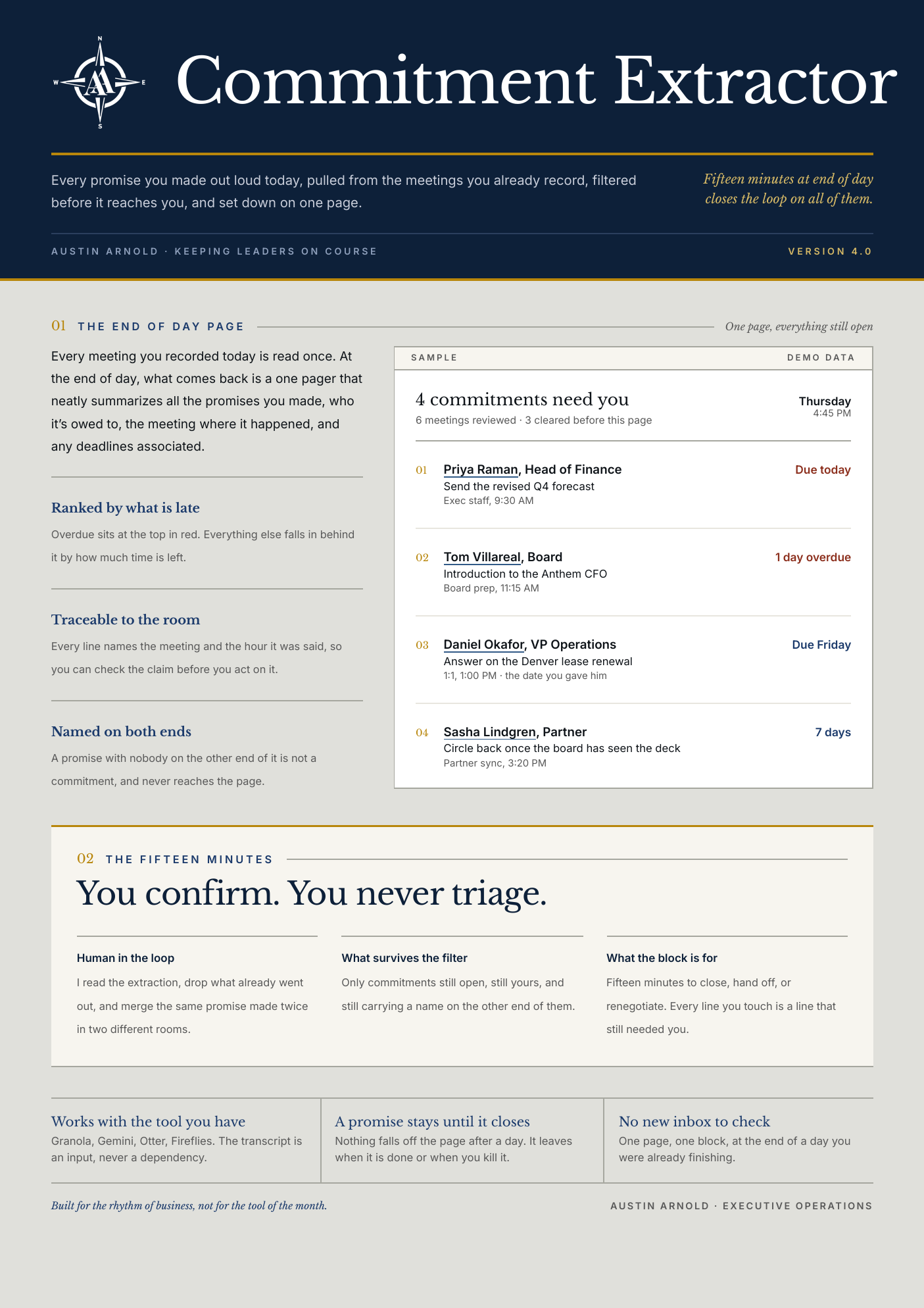
The executive summary of the system, on one page, the way it would be handed to a principal who has ninety seconds.