Case file / E.01 · Concept build
Calendar Ledger
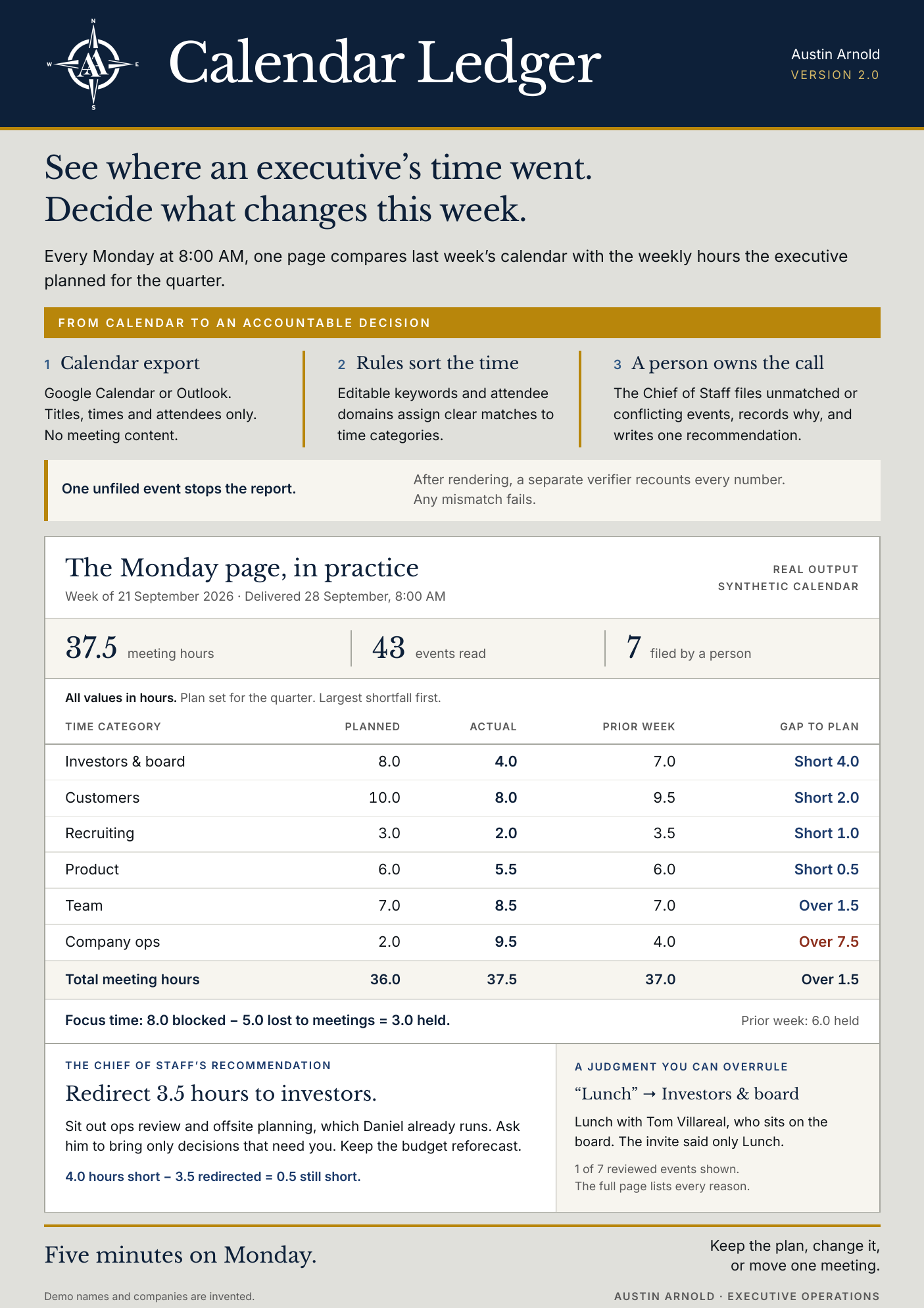
Every meeting on last week's calendar is read once and filed into the buckets the executive set for the quarter. What comes back Monday at 8:00 is a ledger: planned hours against actual, the prior week beside it, focus time actually held, and one move for the week ahead. Five minutes to keep the split, or change it.
The Problem
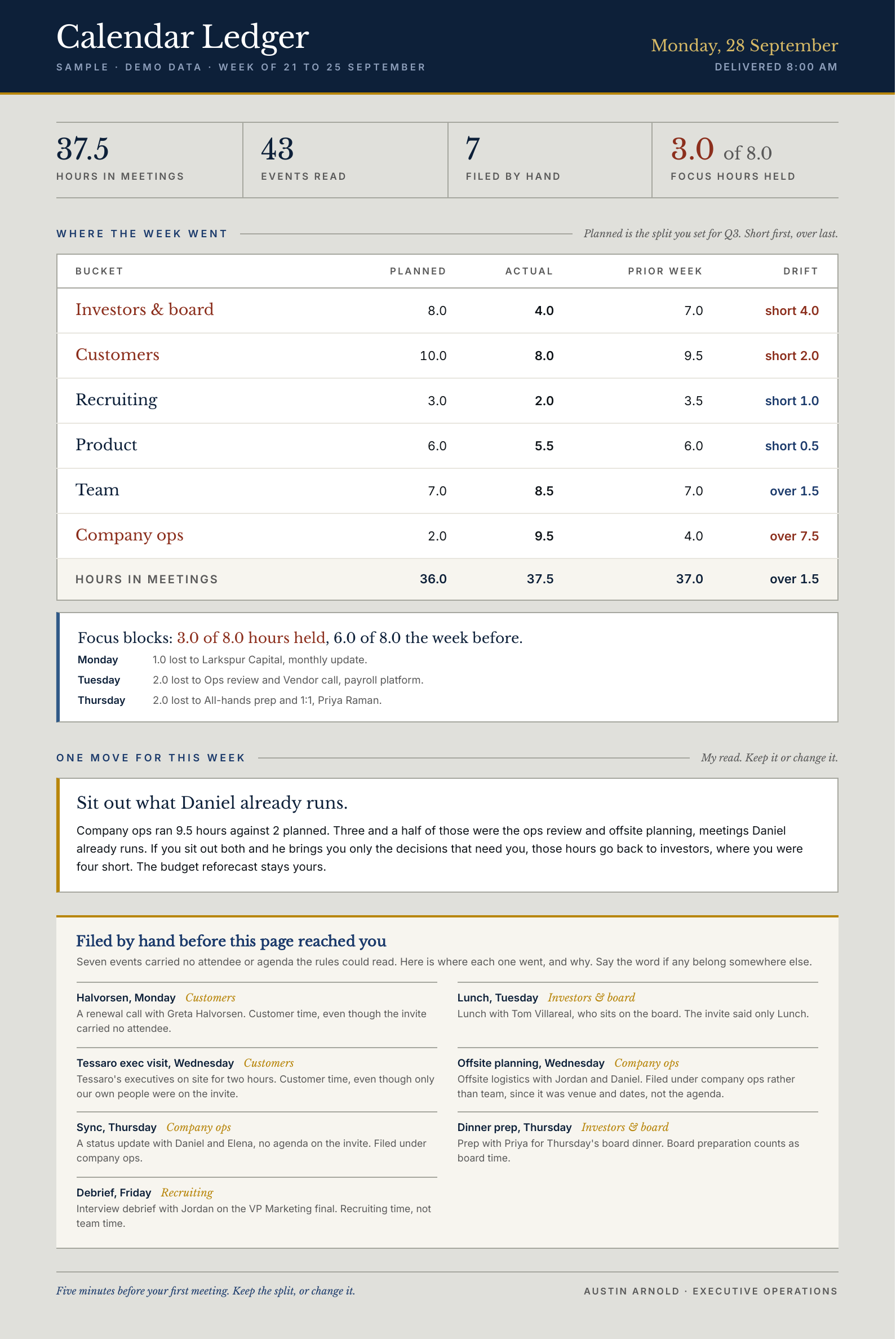
Executives set a split for their time every quarter. So much for customers, so much for investors, so much for the team. Then the week fills one invite at a time, and nobody checks the calendar against the split. By Friday, company ops has eaten the hours meant for investors and nobody noticed, because nobody was counting.
What that costs is the quarter. The priorities were set in January and the calendar has quietly voted against them every week since. Calendar tools count meetings. Almost nothing counts them against what the executive said mattered.
The gap between the split an executive set and the split the calendar delivered is where this lives.
The Solution
The read is a short list of rules, keywords and attendee domains, over the calendar export. No model, because the judgment is in the buckets, not the parsing. Anything the rules cannot read, a lunch with no attendee, a sync with no agenda, goes to a person, never to a guess.
Then a person writes the one move. The page shows the arithmetic: hours in company ops meetings a VP already runs, hours short with investors, and a recommendation that moves the executive's attendance, never a VP's job. It is written, not generated, and it stays on one line so it can be kept or overruled in a sentence.
The executive keeps the split or changes it. They never tally it.
The Ledger
This is what arrives at 8:00 on Monday. Six buckets, short first and over last, with the prior week beside them. Focus blocks counted honestly. One move with its numbers. Every event filed by hand is listed with the reason, so a wrong call takes one sentence to fix.
How it runs
Four steps, and the executive touches the last one.
- Export. The calendar the executive already keeps. Google Calendar or Outlook, titles, times and attendees only, never the content of a meeting.
- File. A short list of rules puts every meeting in a bucket. Change a rule and the ledger changes with it. Anything the rules cannot read goes to a person.
- Read. A human files what the rules could not, lists each one with the reason, and writes the one move for the week. This is the step that makes the page worth opening.
- Deliver. One page, Monday at 8:00, before the first meeting. No new inbox, no new app, no dashboard to log into.
The one pager
The executive summary of the system, on one page, the way it would be handed to a principal who has ninety seconds.